
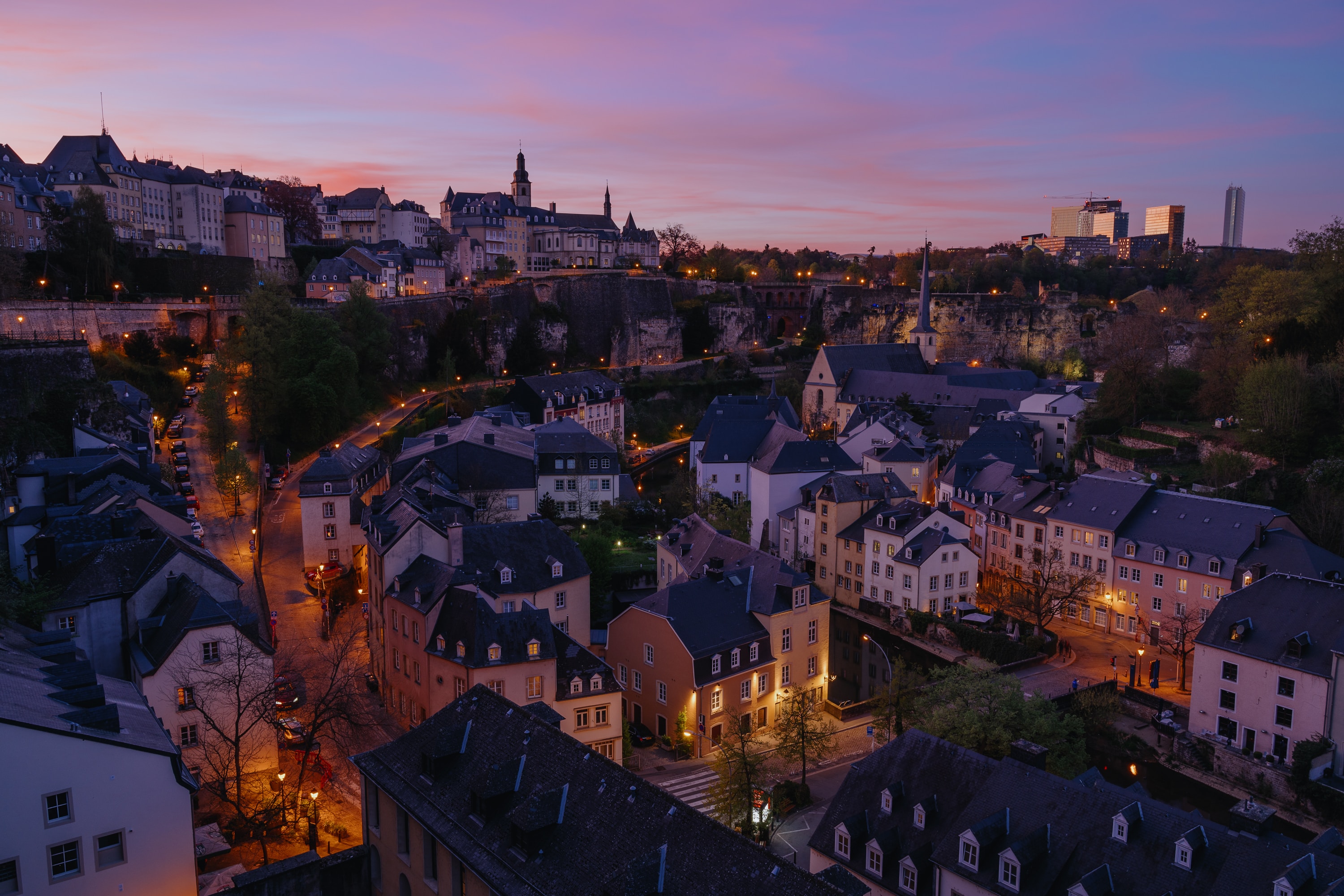
Luxembourg, often described as the ‘Heart of Europe’, is a small yet enchanting country nestled between France, Germany, and Belgium. This landlocked gem enthralls with its blend of diverse cultures, languages, and landscapes.
Luxembourg City, its capital, is a UNESCO World Heritage site and features a captivating mix of old and new, from the fairy-tale-like Old Town with its cobblestone streets and fortified medieval structures, to the modern, glass-fronted buildings of the European Quarter.
The countryside is equally captivating with its rolling hills, dense forests, and picturesque villages, not to mention the stunning Moselle wine region and the rugged beauty of the Ardennes. Despite its small size, Luxembourg boasts a rich historical tapestry, a thriving culinary scene with numerous Michelin-starred restaurants, and a host of outdoor activities, making it a charming destination that offers something for everyone.

Luxembourg City, the capital of the Grand Duchy of Luxembourg, sits at the confluence of the Alzette and Pétrusse Rivers in southern Luxembourg. This location provides the city with a unique, multi-level geography that is characterized by deep gorges and high bridges.
The city’s layout is divided into several districts, each showcasing a different aspect of the city’s topography. The UNESCO-listed Old Quarter, Ville Haute, is perched atop a sandstone plateau with commanding views over the lower quarters, while the Grund and Clausen districts are nestled at the base of the gorge.
The Kirchberg district, a hub of European institutions, bridges the gap between the old and the new, with its modern architecture set against the natural beauty of the Alzette valley. The city’s climate is oceanic, with a significant amount of rainfall throughout the year, relatively mild winters, and warm summers. Luxembourg City’s unique geography, combined with its rich history, gives it a distinctive charm, effortlessly blending its natural, cultural, and architectural landscapes.

Vianden Castle

Nestled in the northern part of Luxembourg, atop a rocky promontory overlooking the quaint town of Vianden, stands the majestic Vianden Castle. This medieval fortress, dating back to the 10th century, is one of the largest and finest feudal residences of the Romanesque and Gothic periods in Europe.
After extensive restorations in the 20th century, the castle now dazzles visitors with its beautifully refurbished rooms, displaying artifacts, weapons, and furniture from different eras. Highlights include the chapel, the grand kitchen, the Byzantine gallery, and the stunning views over the Our valley from the castle ramparts.
Visiting Vianden Castle feels like stepping back in time, providing a fascinating insight into Luxembourg’s rich history and offering a breathtaking panorama of the surrounding landscape. It’s a must-see for any visitor to the Grand Duchy of Luxembourg.
Le Chemin de la Corniche

Often referred to as the ‘most beautiful balcony in Europe’, Le Chemin de la Corniche is a stunning pedestrian promenade in Luxembourg City.
Offering unparalleled views of the Old Town, the Alzette River, and the picturesque Grund and Clausen districts, the Corniche winds along the course of the city’s ancient ramparts. Originally laid out in the 17th century atop the mighty walls built by the Spanish and French, the walkway provides a glimpse into Luxembourg’s historic fortifications, known as the ‘Gibraltar of the North’.
Today, visitors and locals alike enjoy this stroll for its enchanting views, historic charm, and its proximity to key sites like the Bock Casemates and Neumünster Abbey. A walk along Le Chemin de la Corniche is a must-do experience when visiting Luxembourg City.

View from the Le Chemin de la Corniche
Cathédrale Notre-Dame

The Cathédrale Notre-Dame, located in the heart of Luxembourg City, is the only cathedral in Luxembourg and a noteworthy symbol of the city’s religious heritage.
Originally built as a Jesuit church in the early 17th century, the building was later consecrated as a cathedral in 1870. It’s an impressive blend of late Gothic and Renaissance architecture, with added neo-Gothic elements.
Inside, visitors are captivated by the beautiful stained-glass windows, some dating back to the 19th century, the modern sculpture of the Miraculous Virgin, and the crypt that houses members of the Grand-Ducal family.
Its serene ambience provides a tranquil retreat from the bustling city outside. The cathedral’s twin spires are a distinctive part of the city’s skyline, making it a landmark not to be missed while exploring Luxembourg.
The Grund

Grund is a charming and picturesque district in the valley beneath the centre of Luxembourg City. Nestled along the banks of the Alzette River, Grund offers a delightful contrast to the hustle and bustle of the city above.
It is renowned for its beautifully preserved historic buildings, cobbled streets, and serene atmosphere. The district is home to several popular attractions, including the Neumünster Abbey cultural centre and the Natural History Museum. Numerous cosy cafés, pubs, and restaurants dot the area, providing ample opportunities for relaxing and people-watching.
Despite its proximity to the city centre, Grund retains a distinct, village-like tranquillity, enhanced by the river and green spaces. A walk through Grund provides a glimpse into a quieter, more laid-back side of Luxembourg City.

Cobbled street of Grund
Casemates du Bock

The Casemates du Bock is a network of underground tunnels located in Luxembourg City and is a prime example of the country’s rich military past. Originally built in 963 by Count Siegfried as a castle, the site has evolved over centuries into a fortified bastion with 23 km of tunnels that served as a shelter during wars and sieges.
Today, the Bock Casemates are a UNESCO World Heritage Site and one of Luxembourg’s most popular tourist attractions. Visitors can explore the maze of passages that once housed soldiers, horses, workshops, and even bakeries.
Offering a unique insight into the city’s fortifications, as well as stunning views over the Old Town and the Alzette valley, a visit to the Casemates du Bock is a fascinating journey through Luxembourg’s history.

Casemates du Bock
Grand Ducal Palace

Located in the heart of Luxembourg City, the Grand Ducal Palace is a splendid sight and an enduring symbol of the nation’s grandeur. The official residence of the Grand Duke of Luxembourg, it is where he performs most of his duties as head of state of the Grand Duchy.
Originally built in 1572 as the city’s town hall, it was transformed into the Grand Ducal Palace in the 19th century. It’s beautiful facade is a blend of Flemish Renaissance and classical styles, made complete with a guard posted at the entrance. In the summer, guided tours allow visitors to admire the sumptuous interiors, rich with exquisite frescoes, gilded moldings, and luxurious tapestries.
The Palace is not just a reminder of Luxembourg’s historic royalty, but also a working government building that continues to play an active role in the nation’s affairs.
L’église Saint Jean du Grund

L’église Saint-Jean du Grund, or St. John’s Church, is a cherished gem tucked away in the historic and picturesque district of Grund in Luxembourg City.
This quaint church, established in the 17th century, is recognized for its remarkable Baroque architecture and its richly decorated interior. Inside, visitors can appreciate a series of stunning frescoes, a beautifully crafted pulpit, and a number of ornate statues.
Despite its relatively small size, the church exudes a unique charm and a sense of tranquility. Surrounded by the cobblestone streets of Grund and situated near the banks of the Alzette River, St. John’s Church provides a serene and spiritual retreat in the heart of the city.
It serves as a poignant reminder of the enduring faith and history of the local community.
St Michael’s church

St. Michael’s Church, or Église Saint-Michel, is the oldest extant religious site in Luxembourg City. Established in 987, the church has withstood the test of time, surviving city fires, demolitions, and reconstructions throughout its storied past.
Today, it stands as a testament to the city’s resilience, reflecting a blend of architectural styles, including Romanesque, Gothic, and Baroque. The interior of the church is beautifully adorned with ornate altars, stunning stained-glass windows, and a notable statue of Madonna and Child.
Nestled within the heart of the Old Town, the historical significance and tranquil atmosphere of St. Michael’s Church make it a must-visit site for anyone exploring the rich heritage of Luxembourg City.
Public transport

Luxembourg made headlines around the world in 2020 by becoming the first country to offer completely free public transportation nationwide. Its extensive public transport network, managed by various companies, includes trains, trams, and buses.
The train network connects Luxembourg City with other towns across the country, and even extends into neighboring countries like France, Belgium, and Germany. The city’s tram and bus services are both efficient and reliable, providing convenient connections to various neighborhoods, key attractions, and outlying suburbs.
Luxembourg City also has a bike-sharing program, adding another eco-friendly transport option for residents and visitors alike. The country’s commitment to free public transport is a testament to its progressive approach to sustainability, accessibility, and social equality. For tourists, it’s an added bonus, making travel within and beyond Luxembourg City both easy and cost-effective.